
How the Geo-HEP High-Performance Energy Pile Works
Absorbing heat, buffering
thermal loads,
and exchanging energy with the ground.
Geology and Groundwater in Geo-HEP Systems
The performance of a Geo-HEP system depends largely on the geological and hydrogeological conditions of the site. The decisive factor is not a single type of soil or rock, but rather the ability of the subsoil or bedrock to absorb, store, conduct, and release heat.
What properties of the subsurface are examined?
Before sizing the structure, the site is evaluated geologically and—if necessary—hydrogeologically. Key design parameters include:
- Structure and stratification of the subsurface
- Thermal conductivity and thermal storage capacity
- Strength and drillability of the rock
- Groundwater conditions
- Permissible drilling depth
- Distances from buildings and utility lines
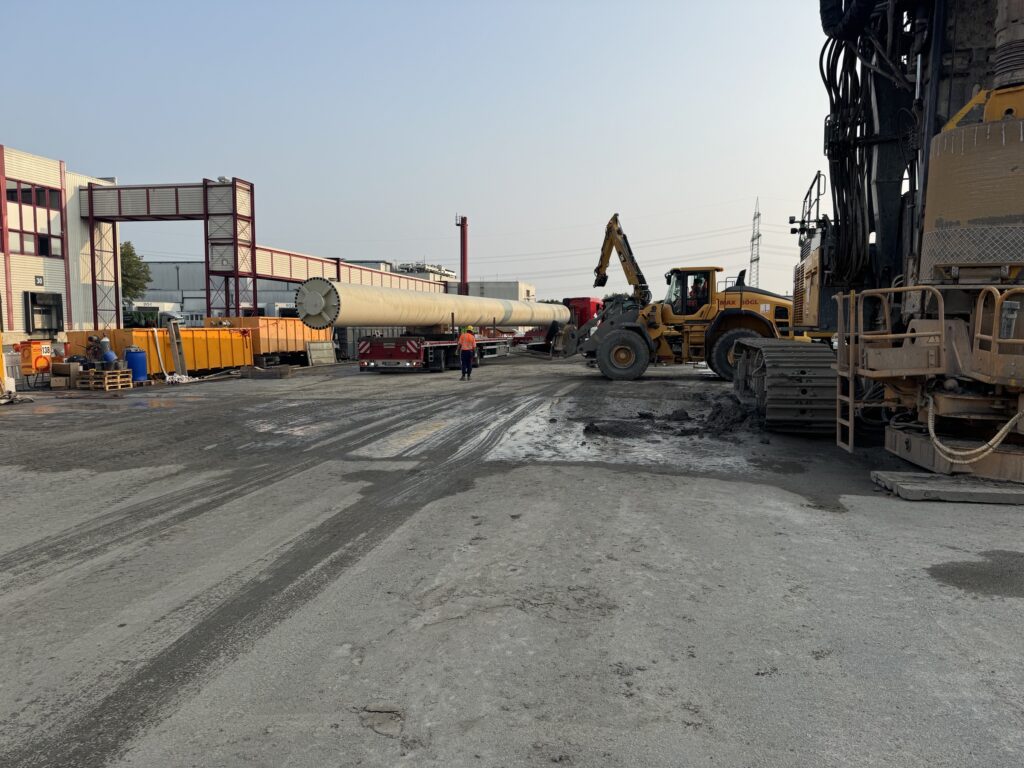
Based on this, we determine the power output achievable per high-performance energy pile and how many energy piles are required for the respective project.
Groundwater as a Natural Heat Carrier
Existing groundwater can significantly influence the thermal conditions of a site. The natural flow of groundwater plays a particularly important role in passive cooling.
Moving groundwater continuously transports the heat injected into the subsurface. This thermally regenerates the area around the high-performance energy pile and reduces heat buildup in the rock mass.
The higher the natural flow velocity of the groundwater, the greater the continuous heat dissipation tends to be. Under suitable hydrogeological conditions, this can significantly enhance the cooling capacity of the Geo-HEP system, particularly during passive cooling operation.
Closed-Loop Heat Exchange System
The Geo-HEP system operates as a closed heat exchange system. Groundwater is neither pumped nor does it form part of the system’s circuit. It acts—provided it is present at the site and in motion—exclusively as a natural heat carrier in the subsurface.
Which groundwater parameters are relevant for the design?
- Groundwater flow velocity
- Flow direction
- Thickness of the aquifers
- Permeability of the bedrock
- Groundwater level and seasonal fluctuations
These parameters influence the achievable cooling capacity, the required number of high-performance energy piles, and thus also the economic efficiency of the entire system.
Even sites without significant groundwater flow are evaluated on a case-by-case basis
A site’s suitability is not determined solely by the presence of groundwater. The decisive factor is the overall assessment, which takes into account geology, hydrogeology, power requirements, and the plant design. The achievable power output and the necessary system sizing are therefore determined individually for each project.
Geology Also Affects Permitting and Economic Feasibility
Site conditions do not only affect heat exchange. Drillability, groundwater conditions, and permissible drilling depth can also influence a project’s eligibility for approval as well as its structural and economic feasibility.
Assess Site Conditions Early
The sooner the geological and hydrogeological conditions are known, the more reliably the design, permitting process, and economic viability of a small-scale hydropower project can be assessed.