
Cost-Effectiveness
Customized Calculation— Based on Project-Specific Conditions
The economic viability of the Geo-Hep system is evaluated individually for each construction project based on the actual project-specific conditions.
A blanket assessment is not helpful in this context, as operating modes, operating times, energy requirements, and existing system technology, in particular, have a significant influence on the economic potential.
As soon as the relevant operational and consumption data—in particular, system runtime, current electricity consumption, power ratings, and other energy-related metrics—are available, we conduct a detailed technical and economic analysis.
Based on this data, we prepare a project-specific ROI (return on investment) calculation. This involves comparing the required investment costs with the expected savings in energy and operating costs.
In addition—provided they are relevant to the specific project and can be reliably assessed—other economic factors
such as energy price trends, operating hours, or different usage scenarios can be taken into account.
The results provide a transparent basis for decision-making and clearly demonstrate the potential savings that can be achieved through the use of the Geo-Heat System, the time frame within which the investment will pay for itself, and the point at which a sustainable economic advantage over the existing system’s operation begins.
Thus, the decision to implement the Geo-Heat System is not made solely on the basis of theoretical assumptions, but rather on the basis of a concrete technical and economic evaluation tailored to the specific construction project.
How the High-Performance Energy Pile Can Reduce Cooling Costs
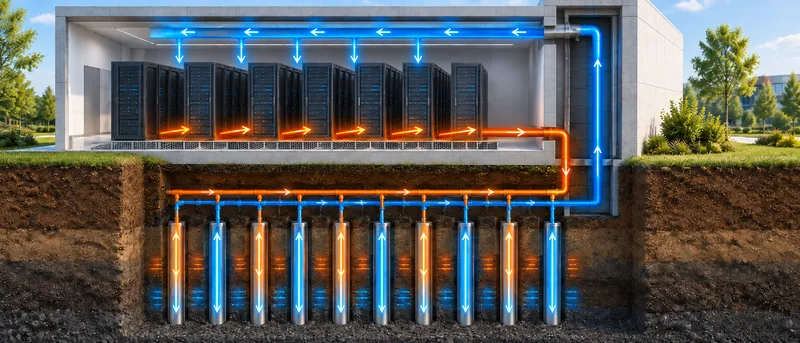
In passive cooling, heat from buildings or technical processes is transferred to the ground via the high-performance energy pile. This reduces the need for electricity-intensive chillers. Electrical energy is still required for the circulation pumps and the system’s controls.
This principle is particularly interesting when there is a regular or continuous need for cooling. The required temperature level, the cooling demand, and the geological and hydrogeological conditions of the site determine how much conventional refrigeration can be replaced.
When is Geo-HEP a good fit for your project?
The key factor is how much in annual costs can be saved compared to your current system or an alternative system you’re planning—and what investment is required to achieve that.
Assess Energy Needs and Operations
Cooling and heating requirements, operating hours, peak loads, and required temperatures form the basis. For existing systems, consumption data and information on the existing technology help assess the savings potential.Jointly Design the Site and System
Subsurface conditions help determine the amount of thermal power that can be transferred. Based on this, the number and design of the high-performance energy piles, hydraulic integration, and pump requirements are determined. Any cooling system that may still be needed is also taken into account.Compare investment and annual costs
The calculation compares planning, construction, and system technology with the expected savings. Electricity consumption, maintenance, upkeep, and, if applicable, financing are factored into the evaluation. Potential subsidies are also considered.
If there is an additional heating requirement, the use of the high-performance energy pile as a heat source for a heat pump is also included in the overall assessment.
Seasonal Storage as a Complementary Development
The Geo-HEP seasonal storage system is being developed to store available heat or cooling over extended periods and make it available as needed. For example, heat generated at a specific time can then be used later.
This is how the storage system is designed
Underground storage units filled with water are connected to form a modular storage array. A stratified charging system is designed to keep different temperature levels as separate as possible and enable targeted charging and discharging.
The high-performance energy pile utilizes heat exchange with the subsurface. Seasonal storage focuses on long-term storage in a system specifically designed for this purpose.
Pilot Project with Existing Area Calculation
A calculation of area and layout is available for the seasonal storage system. It shows how a storage array could be configured. The system is currently in the pilot phase; a reliable economic feasibility analysis is not yet available.
For this assessment, factors such as heat losses, usable energy quantities after storage, operating expenses, and investment costs must be determined. At this time, it is not yet possible to draw conclusions regarding savings or payback periods based on this information.
Assess the Economic Viability of Your Project
Would you like to know what potential the Geo-HEP high-performance energy pile offers for your business or building? Information on energy consumption, operating hours, and existing heating and cooling systems forms the basis for a customized assessment.